
Where to begin with Sheikh Imran Nazar Hosein: a reading order
No author section in our store draws more questions than the shelf carrying the works of Sheikh Imran Nazar Hosein. We stock forty of his titles — more than any other author in our catalogue — and the question customers ask, in the shop and over WhatsApp, is almost always the same: which one first?
It is a fair question. His books form a connected body of work, written over decades, and they reward being read in a deliberate order rather than at random. This guide maps the path we suggest to readers who walk in cold. It is a bookseller's map, not a scholar's endorsement: we describe what each book sets out to do, and we leave the judging of arguments to you and to your teachers.
Who is Sheikh Imran Nazar Hosein?
Imran Nazar Hosein is a Trinidad-born Islamic scholar best known for his work on Islamic eschatology — the study of akhir al-zaman, the end times — and for reading the modern world through the lens of the Qur'an and the Sunnah. He studied under the late Maulana Dr. Muhammad Fazlur Rahman Ansari, and many of his books are published as the Ansari Memorial Series in his teacher's honour — you will see that series name printed on several of the titles below.
Two things make his writing distinctive. The first is method: he insists the Qur'an must be studied as a whole, with verses illuminating one another, and that this system of meaning can then be brought to bear on the present age. The second is subject matter: money, war, Jerusalem, Gog and Magog, Dajjal — themes many contemporary authors avoid, examined at book length.
That distinctiveness is also why he divides readers. His interpretations of current events are his own ijtihad, and some of his conclusions are contested by other scholars. We say this plainly because it is the honest frame for everything that follows: these are serious, argued books, and they deserve a serious, critical reader. Read him alongside classical tafsir, take what stands up, and discuss what does not with people of knowledge you trust.
Start with the method, not the conclusions
The mistake most first-time readers make is starting with his most famous conclusions — the eschatology — without first understanding how he reads the Qur'an. His conclusions all rest on a methodology, and he wrote a book about exactly that. Methodology for Study of the Qur'an sets out his system: how verses connect, how the Qur'an interprets itself, and how a reader moves from text to world. It is the skeleton key to everything else on this shelf, and our edition is the second edition of the work.
From there, go straight to Surah al-Kahf. He regards this chapter — the one Muslims are urged to read every Friday — as the Qur'an's principal briefing on the trials of the modern age. He treats it in two companion volumes: Surah al-Kahf: Text, Translation and Commentary gives you the surah itself with his verse-by-verse commentary, while Surah al-Kahf and the Modern Age applies its themes — faith versus materialism, knowledge, power, Dhul-Qarnayn — to the world we actually live in. Read the commentary first, the application second.
These three books are, in our experience, the difference between a reader who follows his later arguments and one who bounces off them. They are also self-contained: if you read only this far, you will still have received the core of his approach to the Qur'an.
The central book: Jerusalem in the Qur'an
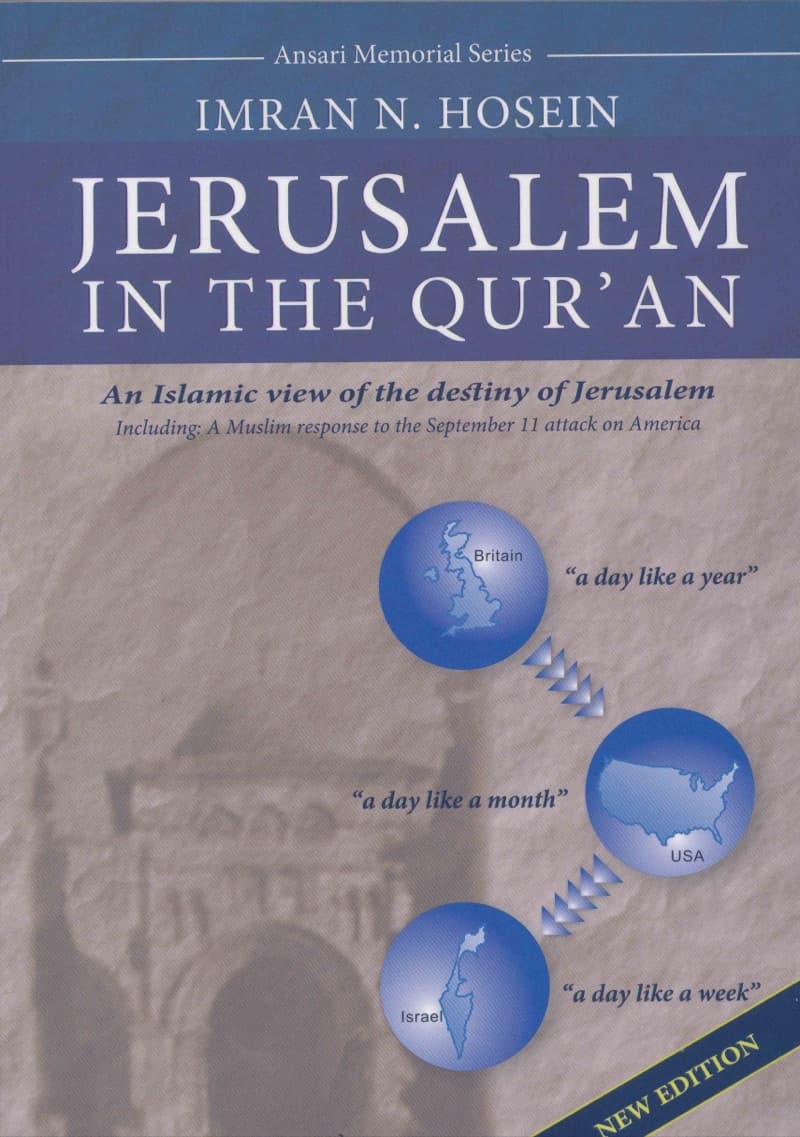
If his bibliography has a centre of gravity, it is Jerusalem in the Qur'an. This is the book most readers eventually arrive at, and the one his name is most attached to. It presents an Islamic view of the destiny of Jerusalem — what the Qur'an and the Ahadith say about the Holy Land, how its modern history should be read in that light, and what a Muslim response to the struggle over it might look like.
It is a demanding book, which is precisely why we do not recommend it first. Its argument leans on the reading method and on the Surah al-Kahf material above; readers who arrive with that preparation tend to finish it, and readers who start here often stall a third of the way in. Taken in order, though, it is the payoff of the whole path — the book where his method is applied at full scale to a single, urgent subject.
For Malay-reading households, the same work is available in translation as Jerusalem di dalam Qur'an, and we keep both editions in stock. It is common for our customers to buy the English for themselves and the Malay for a parent — the two texts make the same argument to two generations.
The money books
Alongside eschatology, the second pillar of his work is money. The Gold Dinar and Silver Dirham — subtitled Islam and the Future of Money — is the short, accessible statement of his position: that the paper and electronic money of the modern world differs in kind, not just in form, from the money known to the Prophet's ﷺ community, and that this difference carries religious weight. It is one of the most-requested titles in our shop and a sensible fourth book on this path.
Pair it with The Importance of the Prohibition of Riba in Islam, a compact treatment of why the Qur'an's ban on riba sits at the centre of his economic thinking. The two together take an evening or two each and give you his monetary argument in miniature.
Readers who want to test that argument against the broader field of Islamic economics — including authors who defend the existing Islamic banking system he criticises — should continue with our companion guide, The gold dinar debate, which maps the rest of our Banking, Finance & Economics shelf around exactly this dispute.
The wider arc: an eschatological library
With the method, Surah al-Kahf, Jerusalem and the money books behind you, the rest of the shelf opens up. These titles extend the same argument across history and geography, and they can be read in almost any order. We describe each honestly, so you can pick by interest.
The Qur'an, the Great War and the West — an Ansari Memorial Series title on al-malhama, the great war of the end times, and how he locates the modern West within that prophecy. It has long been one of the best-selling books in our store, and its brevity makes it a natural first pick from this group.
An Islamic View of Gog and Magog in the Modern World — his longest single investigation, the fruit of a study he began in the early 1990s, on the identity and role of Ya'juj and Ma'juj. This is the book where his willingness to name the actors of the modern world is at its most direct, and where a critical reader will have the most to weigh.
Constantinople in the Qur'an — on the prophesied conquest of Constantinople and what the city's history since means for the Muslim world. Shorter and more focused than the Gog and Magog volume; readers interested in Turkey and the Ottoman story tend to start here.
Dajjal, the Qur'an and Awwal al-Zaman and The Messiah, the Qur'an and Akhir al-Zaman — a pair on the two ends of sacred history: the beginning of the story and its climax in the figure of the false messiah and the true one. They are among his later works and assume familiarity with the earlier books; we suggest them near the end of the path, not the start.
Shorter companions, and the Malay editions
Not everything on this shelf is a heavy argument. Several short books make good companions between the larger volumes. The Qur'an and the Moon presents his method for a monthly recitation of the Qur'an tied to the lunar month — a devotional book rather than a polemical one. One Jama'at, One Ameer addresses how a Muslim community should organise itself in an age of fitan, and Fasting and Power reflects on the strategic significance of the fast of Ramadan. In Search of Khidr's Footprints in Akhir al-Zaman is the slimmest of all — a meditation on the figure of Khidr that pairs naturally with the Surah al-Kahf volumes.
Finally, a note for bilingual families: beyond Jerusalem di dalam Qur'an, several of his works are available from us in Bahasa Melayu, including the Dajjal volume and the Gog and Magog study. If you are buying for a parent or a study circle that reads more comfortably in Malay, search the author's name in our shop and filter for the Malay editions — the translations follow the same reading order given here.
However far along this path you go, our counsel stays the same as in the first section: read him with the Qur'an open beside you, test what you read, and treat the books as an invitation to study rather than a substitute for it. That is how the strongest readers of this shelf — and there are many in Malaysia — have always used it.