
Choosing Your First English Qur’an Translation: A Review of The Guidance for Mankind
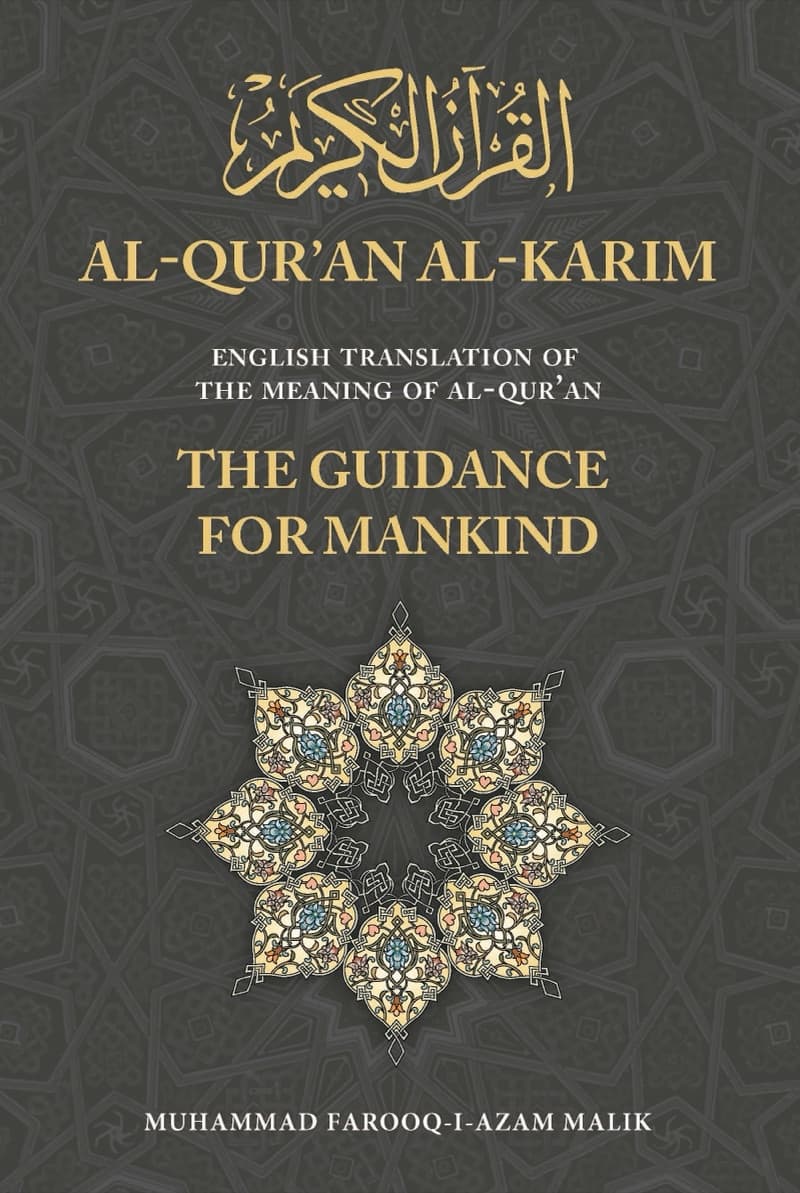
Selecting an accessible, clear, and reliable translation of the Qur’an is a vital first step for non-Arabic speakers and new students of Islamic knowledge.
Al-Qur’an Al-Karim: The Guidance for Mankind, translated by Muhammad Farooq-i-Azam Malik, stands out as an introductory English translation designed specifically for contemporary readers seeking clarity, context, and ease of understanding.
Since 1996 we have been putting Qur'an translations into readers' hands, and the first conversation is always the same. Someone — a new Muslim, a student, a parent buying for an English-schooled teenager, a non-Muslim colleague who wants to read the book for themselves — stands in front of a shelf of solemn green and gold spines and asks: which one?
There is no single right answer, and anyone who tells you otherwise is selling something other than books. But there are right questions, and after almost three decades of these conversations we know what they are. This guide walks through them, using the editions we actually carry — no theoretical recommendations for books you cannot buy here.
1. Dual-Text Presentation
Features clear Arabic script side-by-side with modern, direct English rendering, allowing readers to reflect on the meaning while staying connected to the original text.
2. Extensive Introductory Sections
Includes detailed preliminary resources such as a translator's introduction, an overview of the Prophet Muhammad's ﷺ mission and life, historical notes on the compilation of the Qur'an, and articles on core Islamic beliefs.
3. Study Aids & Reference Tools
Equips readers with a glossary of Quranic words and terms, guidelines for studying the text, a breakdown of Surahs by Juz' (parts), and indices for thematic reference.
4. Contextual Framing
Provides section summaries and explanatory notes alongside verses (such as detailed commentary on Surah Al-Baqarah) to help readers understand the historical background and practical applications of divine guidance.
5. Final Verdict
For readers embarking on their journey to study the Qur’an in English, Muhammad Farooq-i-Azam Malik’s translation offers an ideal combination of readability and academic scaffolding. Its rich introductory context and structured layout make it an excellent choice for a first English Qur’an translation.
First, know what a translation is — and is not
Muslims hold that the Qur'an is the speech of Allah in Arabic, and that no rendering into another language is the Qur'an itself. That is why nearly every serious English edition is titled with a caveat — The Meaning of the Holy Qur'an, English Translation of the Meaning of Al-Qur'an, and so on. A translation is one scholar's careful interpretation of the meaning, made so that a non-Arabic reader is not shut out of the book entirely.
This is not a technicality; it is the most practical fact in this guide. It means, first, that owning two translations is not a redundancy — comparing renderings is one of the best ways for an English reader to sense the depth of the original. And it means, second, that the perfect translation does not exist. The one that matters is the one whose English you will keep reading past page fifty.
One more piece of shop vocabulary before we begin: on our product pages you will see H/C and S/C for hardcover and softcover, and phrases like 'meaning only' or 'translation only' for editions that print the English without the Arabic text alongside it. Those format words change the price and the use of a book far more than most buyers expect, as you are about to see.
The three kinds of edition on our shelf
Almost every Qur'an edition we sell falls into one of three shapes. Parallel text editions print the Arabic and the English side by side — the natural choice if you are learning to read the Arabic, want to follow along in the mosque, or simply want the original present on the page. Meaning-only editions drop the Arabic and give you a book you can read like a book: lighter, cheaper, and far better for continuous reading on a commute. Commentary editions surround the translation with footnotes and essays — background on when and why verses were revealed, discussion of difficult passages, cross-references.
Match the shape to the job. A first-time reader who mainly wants to understand is usually best served by a meaning-only or lightly annotated edition. A household reference — the copy that lives on the shelf and is consulted for decades — should be a hardcover parallel-text edition with commentary. Many of our customers end up with one of each, and that is not the bookseller in us talking: they are genuinely different tools.
Size matters more than people admit, too. A pocket-sized edition that lives in your bag will get read; a majestic hardcover that stays home may not. We say this as people who sell the majestic hardcovers.
The classic voice: Abdullah Yusuf Ali
For much of the twentieth century, the English-speaking Muslim world learned its Qur'an through Abdullah Yusuf Ali. His translation, first published in the 1930s, remains one of the most widely printed English renderings ever made, and his voice — elevated, slightly archaic, unmistakably literary — is still what many readers hear when they think of the Qur'an in English.
We carry it in two very different forms. The Meaning of the Holy Qur'an: Text, Translation and Commentary is the full edition: Arabic text, his translation, and the extensive footnote commentary that made the work famous. This is the classic household reference described above — a book bought once and consulted for a lifetime. At the other end of the scale, The Meaning of the Holy Qur'an: Pocket Sized Edition puts the same translation in a format that travels.
Should you start with Yusuf Ali? If you enjoy literary English — if thee and thy do not slow you down — his remains a rewarding, rich reading. If that register feels like a barrier between you and the meaning, be honest with yourself and choose a contemporary rendering instead; the next section is for you. There is no piety in buying a translation you will not finish.
In the same classic family, we also stock Translation of The Glorious Qur'an in an affordable softcover, and The Holy Qur'an: Text and Translation in paperback — plain parallel-text editions without heavy commentary, for readers who want the traditional register with the Arabic alongside and nothing else on the page.
Plain modern English: the Guidance for Mankind
If the classic register is not for you, the edition we most often place in first-time readers' hands is Muhammad Farooq-i-Azam Malik's Al-Qur'an: The Guidance for Mankind. Its English is contemporary and direct — sentences a modern Malaysian reader parses at first sight — and it is arranged for study, with surah introductions that orient you before each chapter begins.
We have a particular relationship with this work: the hardcover English Translation of the Meaning of Al-Qur'an — The Guidance for Mankind sits in our own-publications shelf, which means it is a book we stand behind with our name and not merely one we distribute. It comes in the formats discussed earlier: the full hardcover, and a lighter 'meaning only' edition that drops the Arabic text for continuous reading. There is also a compact Al-Qur'an: The Guidance for Mankind edition at the gentlest price point on this list, which is why it is our default suggestion for students.
The honest caveat, as with every translation in this guide: Malik's renderings are his interpretation, as Yusuf Ali's are his. For everyday comprehension the differences rarely matter; for points of law or theology, no translation should be your final stop — ask a teacher, and compare renderings.
For the study shelf: Muhammad Asad
One translation on our shelf is less a first Qur'an than a second one: Muhammad Asad's The Message of the Qur'an. Asad — born Leopold Weiss in the Austro-Hungarian empire, and one of the twentieth century's most remarkable converts to Islam — produced a translation dense with footnotes in which he argues for his renderings, engages the classical commentators, and reasons through difficult passages rather than passing over them.
Readers either love this or find it exhausting, and both reactions are fair. His interpretive choices lean rationalist and are debated — some of his readings of miraculous passages, in particular, differ from the mainstream of classical commentary — which is exactly why serious students keep him within reach: he shows his working like no one else. Our edition is the full hardcover, a substantial volume that belongs on a desk rather than in a bag.
Our advice: do not make Asad your only Qur'an. Make him the one you argue with once a plainer translation has made you comfortable in the text.
Companions, and reading with your family
A few inexpensive companions multiply the value of whichever translation you choose. The Complete Easy Dictionary of the Qur'an gives word-to-word translation with basic Arabic grammar — the bridge for readers who want to stop depending on translation altogether, one word at a time. And for adults starting from zero with the Arabic script, Learn to Read the Holy Qur'an in 7 Days by Alpha Mahmoud Bah is the primer we recommend most often; the title is ambitious, but the method is genuinely gentle.
For families, The Holy Quran for School Children — Part 30 (Juz 'Amma) presents the last thirtieth of the Qur'an — the short surahs children memorise first — with text, translation and transliteration together. It is a fine way for a parent and child to read the same pages at their own levels, and many of our customers buy it alongside their own first translation.
How to choose — and how to actually read it
Reduced to a sentence per reader: if you love literary English, start with Yusuf Ali; if you want plain modern prose, start with the Guidance for Mankind; if you are a student of the text, add Asad; whatever you choose, prefer the format — parallel, meaning-only, pocket — that matches where and when you will really read.
Then read it the way the book asks to be read: a little, regularly. A juz' a month with attention beats a whole Qur'an skimmed in Ramadan and shelved in Syawal. Keep a pencil for the margins. When a verse stops you, sit with it, compare a second rendering if you own one, and bring the question to someone learned — a translation is a door into the Qur'an, and doors are for walking through, not for standing in.
And if you are still unsure after all this, do what our walk-in customers do: message us on WhatsApp with who the reader is, and we will talk it through. Matching readers to Qur'ans has been the best part of this job since 1996.